Build an Email List as a Creator Before You Chase Followers
How to build an email list as a creator from zero: your first 100 subscribers, lead magnets that convert, and a 5-email welcome sequence that sells.

To build an email list as a creator, offer one specific free resource in exchange for an email, put the sign-up link everywhere people already find you (your bio, posts, DMs and checkout), and send a short welcome sequence so new subscribers hear from you right away. Start before you have followers: the list is the audience you own.
I've watched creators with 50,000 Instagram followers launch a product and make $0, and creators with 800 email subscribers sell out a $97 workshop in 48 hours. The difference wasn't niche or content quality. It was whether they owned the channel they were talking into. If you want the capture and the follow-up in one place, shopspace puts lead magnets, email sequences and Instagram comment-to-DM on the Creator plan for $19 a month billed yearly, with 0% taken per sale.
Why an email list beats a follower count
Every social platform is rented land. The algorithm changes, reach drops, the platform shifts its priorities, and your audience goes with it. Platforms make those decisions for their business, not yours.
An email list is the one channel where you control delivery. A post reaches whoever the algorithm decides to show it to. An email lands in the inbox of every person who asked for it. Subscribers opted in to hear from you, which makes them far more likely to read and buy than someone who scrolled past a post. And you can export the list and take it with you to any tool.
It also compounds. Each subscriber stays until they choose to leave. Each new follower gets diluted by the feed. The list grows in value the longer you keep it.

Your first 100 subscribers
Forget 10,000. The milestone that changes things is 100: proof that real people want to hear from you, and a feedback loop you can learn from. Getting there is a repeatable process.
Tell people directly. Post on every platform you already use: "I'm starting a newsletter. Here's what it's about. Here's the link." Do it once a week for a month. People who already know you will sign up first.
Make one piece of content that earns the sign-up. A tutorial, a breakdown or a resource that answers the question people ask you most. Then every time the question comes up, you have somewhere to send them.
Make the form impossible to miss. Not buried in a footer. In your link in bio, your email signature, and at the end of everything you publish. Mailchimp reports that its users saw their list growth rate rise by an average of 50.8% after adding a pop-up form to their site (source). Visible beats hidden.
The goal isn't to be clever. It is to remove every reason someone has not to subscribe.
What to offer in exchange for an email
"Lead magnet" has been ruined by years of 47-page PDFs nobody reads. The ones that work are specific, fast and useful, and they match what the person was already looking for when they found you.
Formats that convert:
- A one-page cheat sheet or checklist someone can use in the next ten minutes.
- A short email course, three to five emails over a week, that teaches one real thing and builds the relationship on autopilot.
- A free live session or webinar where registration asks for an email.
- Early access or a discount on your first product, if you already sell something.
- A short list of the tools you actually use. "The 12 tools I use" beats "The Ultimate Resource Guide" every time.
The test: would someone pay $5 for this if you charged for it? If yes, it is a good lead magnet. If no, it is filler.
On shopspace, a lead magnet is one of the product types you can create: a free download that collects the buyer's email before it hands over the file. Webinars and events are a product type too. If your lead magnet later grows into a paid product, digital product pricing strategies covers how to price it.
Where to put your sign-up form when you have no traffic
You don't need traffic. You need placement.
Your link in bio is your most visited page before you have a website. Point it at the lead magnet, not a generic homepage.
Your posts, through the comments. End a post with "comment CHECKLIST and I'll send it to you," and let an automation reply to each commenter by DM with the link to your lead magnet. Comments are engagement too, which can help the post reach more people while it grows the list. How Instagram comment-to-DM works walks through the setup, and on shopspace it is part of the Creator plan.
Collaborations. Guest posts, podcasts and collab videos put you in front of someone else's audience once. Send them to a page that captures the email, not to your profile.
Keep the form short. Ask for an email and at most a first name. Every extra field costs sign-ups, and say in one line what they will get and how often.
Turn every buyer into a subscriber
Most creators treat the list and the store as separate things. They shouldn't be. Someone who buys from you already trusts you enough to spend money, which makes them the most valuable subscriber you can have.
So make the store part of the list. On shopspace, automations run on store events, so a purchase or a lead magnet download can start an email sequence without you lifting a finger. Keep buyers and browsers in separate segments so buyers hear about the next product and browsers hear why the first one is worth it. The list and the store become one loop: content brings people in, the lead magnet captures them, emails build trust, the store sells, and each buyer stays on the list for the next launch.
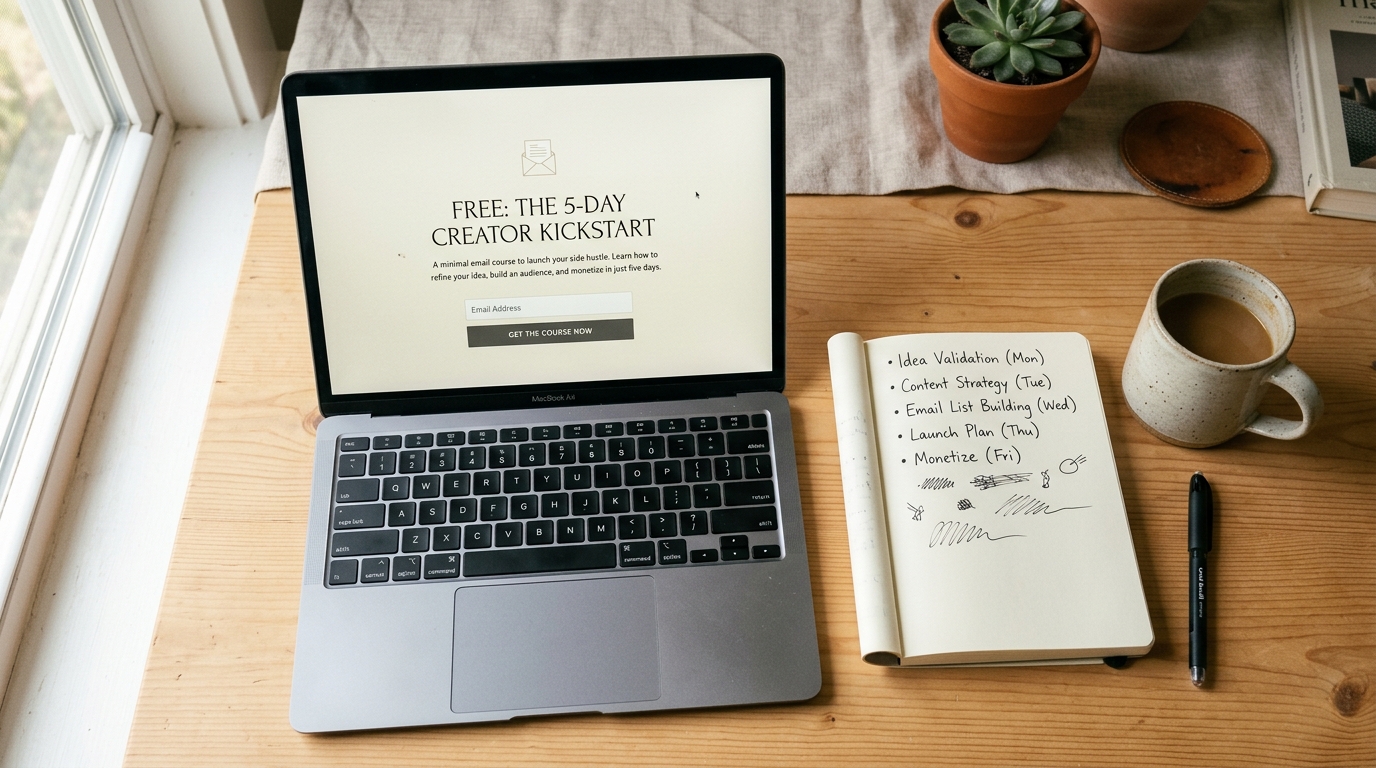
The welcome sequence that does the selling
The first emails someone gets are the ones they are most likely to open. Write them once and let them run for every new subscriber:
- Deliver what you promised, straight away, and say what to expect from you.
- Tell the story of why you make what you make, in a few short paragraphs.
- Send your single best free piece, the one that answers the question people ask most.
- Make a soft offer: the product that solves the next problem, with one clear link.
- Ask a question. "What are you stuck on right now?" The replies tell you what to make next.
This is the part most list advice skips, and it is where a list turns into sales. Creating effective sales funnels for digital products goes deeper on the offer.
Keep the list warm
A list you only email when you are selling goes cold. Opens drop, unsubscribes rise, and the goodwill is gone right when you need it.
The fix is simple: send one email a week that isn't selling anything. Something you noticed, a lesson you learned, a resource you found useful. Keep it short and easy to read on a phone, where most people will open it. Consistency matters more than polish.
Once a few hundred people are on the list, ask them to share it. "Know someone who'd find this useful? Forward it to them" costs nothing and brings in exactly the kind of subscriber you want.
What to measure
Track four numbers each month: new subscribers, unsubscribes, clicks, and sales from email. Treat open rates as a rough signal only, because some email apps load messages automatically and inflate them. Clicks and sales tell you what is working. If growth stalls, the fix is almost always placement or the lead magnet, not the emails.
What your list is worth in money
A list is worth what it sells. Say your list brings in $500 a month in product sales today and $2,000 once it grows. The platform you sell on then takes its share, either as a percentage of each sale or as a flat monthly price. Card processing (Stripe or PayPal) applies on every platform, so it is left out to keep the comparison fair. The 10% below is illustrative, not any one platform's rate.
| Monthly sales from your list | Platform taking 10% per sale | You keep | shopspace Creator ($19 a month billed yearly, 0% per sale) | You keep |
|---|---|---|---|---|
| $500 | $50 | $450 | $19 | $481 |
| $2,000 | $200 | $1,800 | $19 | $1,981 |
Below about $190 a month in sales, a 10% cut is the cheaper model. Above it, a flat price keeps more of everything your list earns.
Once your list sells $2,000 a month, a 10% cut is $2,400 a year of sales you worked for. Start a 7-day free trial of shopspace and keep it: 0% per sale, flat $19 a month billed yearly.
If you are still at zero buyers, how to get your first 100 customers as a creator pairs with this guide.
The verdict
Start the list today, before the follower count feels big enough, because it never will. Pick one lead magnet worth $5, put the link in your bio and at the end of every post, let comment-to-DM do the sending, write a five-email welcome sequence, and email once a week without selling. Everything else is refinement.
If you want the lead magnet, the sequence, the Instagram automation and the store in one place, try shopspace free for 7 days. A card is required at signup, nothing is charged for 7 days, and you pay nothing if you cancel inside the trial.