How to Price an Online Course (Without Guessing)
Online course pricing without guesswork: one-time vs subscription vs cohort, a three-tier stack, a simple formula, and when to raise your price.

Online course pricing comes down to three decisions: which model fits your content (one-time, subscription or live cohort), where to set your tiers, and when your results justify a higher price. Choose the model first, then the number, start conservatively if you have no testimonials yet, and raise the price as proof comes in.
Where you host the course matters too, because a platform that takes a cut of every enrolment takes it from every price you pick. shopspace charges 0% per sale for a flat $19 a month billed yearly, with courses, memberships and coaching bookings in the same store.
The three pricing models: one-time, subscription and cohort
Before you pick a dollar amount, pick a structure. The three models work very differently.
One-time purchase. The student pays once and keeps access. Best for self-paced courses with a clear outcome, such as "edit photos in Lightroom in 30 days" or "build your first Notion system". Revenue arrives in bursts around launches.
Subscription. The student pays monthly or yearly for ongoing access. It works when your content keeps growing (a monthly workshop, a live Q&A library) or when the value builds over time. The risk is churn: a student who finishes in month two tends to cancel in month three.
Cohort or live course. A fixed start date, a group of students and a defined end. You can charge more for the live access and accountability, but it costs your time.
The same material can be sold as a self-paced course, a monthly membership or a live cohort with coaching. None of those is wrong. They are different products at different prices.
Why most creators price too low
The instinct to charge $19 or $29 comes from fear of rejection. It feels safer to charge less because at least people will buy.
The arithmetic disagrees. To make $10,000 at $29 you need 345 buyers. At $297 you need 34. For many creators, finding 34 people serious enough to pay $297 is easier than finding 345 casual buyers, and the serious ones are more likely to finish the course and recommend it.
Price also sends a signal. A very cheap course reads as a PDF with a video attached. A higher price reads as a result someone is prepared to stand behind. Frame the price against the outcome: if your course helps a freelancer land one $500 client, $97 is an easy decision for them.
How to price your course with a three-tier stack
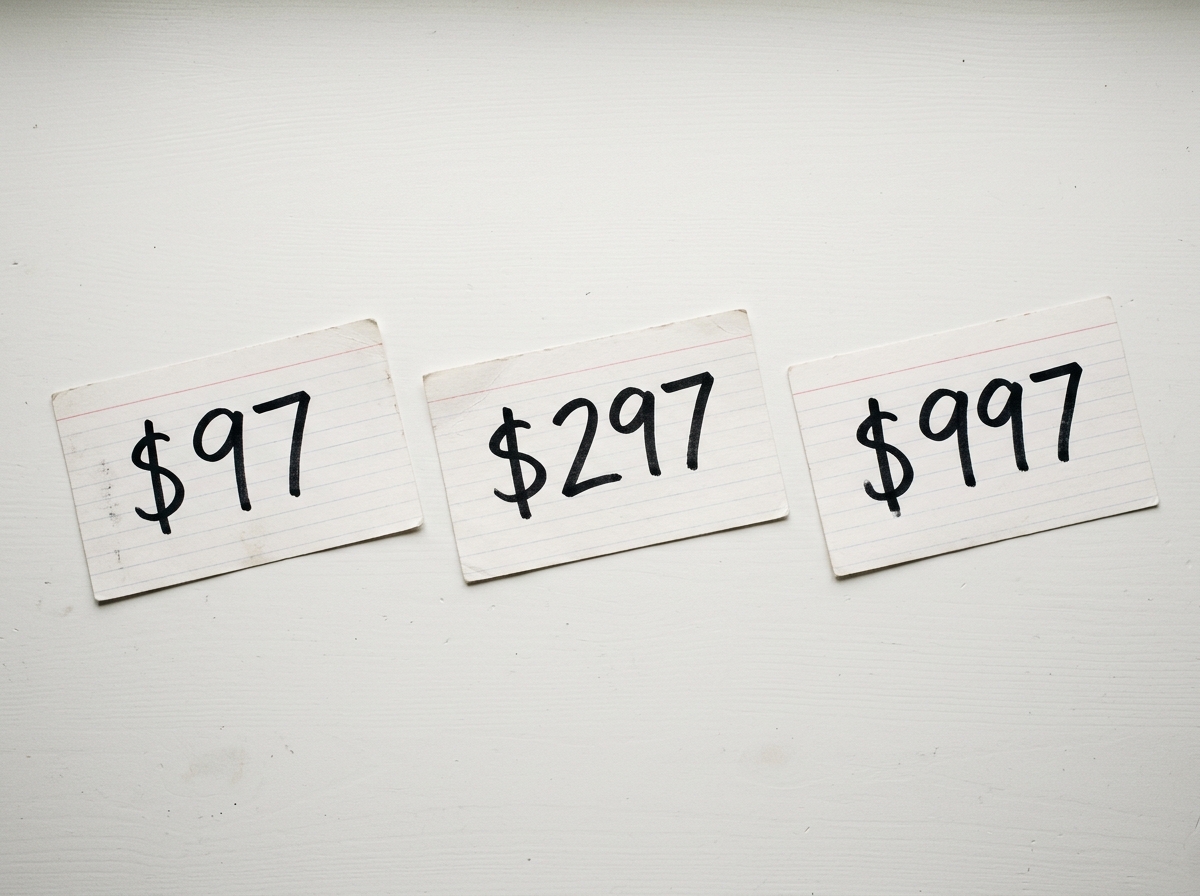
A useful structure is not a single price but three tiers. The tiers do two jobs: they make the middle option look like the obvious choice, and they let buyers pick their level of commitment. A common example stack looks like this:
| Tier | Example price | What is included | Who it suits |
|---|---|---|---|
| Core | $97 | Self-paced video lessons and a workbook | Independent learners |
| Complete | $297 | Core plus templates and live Q&A calls | Students who want support |
| Coaching | $997 | Complete plus one-to-one or group coaching | Buyers who want it done with them |
These numbers are an example, not a rule. What matters is the gap between tiers. The middle tier tends to sell best because buyers compare it with the options next to it rather than judging it alone: next to $997 it feels reasonable, and next to $97 the core tier looks thin. This is price anchoring. Launch with two tiers and add coaching once testimonials back it up.
On shopspace, each tier maps to something you can already sell from one store: the course itself (with progress tracking), a bundle that pairs the course with your templates, and bookings for the coaching calls. A live Q&A can run as a webinar, live or recorded.
When subscription pricing makes sense
Subscription works when the value is ongoing, not one-time.
Good fits:
- A monthly workshop or masterclass series
- A content library that grows every month
- A community with live coaching calls (see how to build a paid membership site)
Poor fits:
- A finite course with a clear end ("12 modules, done"), because students cancel after finishing
- A topic that does not change, where there is nothing new to deliver next month
If you are unsure, start with a one-time price. Adding a subscription tier later is easy. Moving existing subscribers to a one-time price is much harder to explain.
A simple formula instead of a pricing calculator
You do not need an online course pricing calculator. You need four inputs:
- Outcome value. What is the student's realistic gain in money or time from finishing the course?
- Your proof. No testimonials means pricing conservatively. Many specific results means pricing closer to full value.
- Audience warmth. A warm email list tolerates a higher price than cold social traffic.
- Completion requirement. If students only get the value by finishing, the price carries more risk for them.
A rule of thumb (a starting point, not research): price = 10% of the outcome value, multiplied by a proof factor. Use 0.5 with no testimonials, 0.75 with a handful, and 1.0 with ten or more strong ones.
Example: the course helps a freelancer land a $2,000 client. 10% of that is $200. With ten strong testimonials the factor is 1.0, so $200, which you might round up to $297 if the Complete tier includes live support. With no testimonials it is $100, so $97 is a sensible launch price.
What platform fees take from a course sale
Course prices are higher than most digital products, so a percentage fee takes a bigger bite per student. On a $297 course, a platform taking 10% keeps $29.70 of every enrolment.
The table below compares what the platform takes at two monthly revenue levels. The 5% and 10% columns are illustrative percentage cuts, not a specific platform, so check your own platform's pricing page. Card processing (Stripe or PayPal) applies on every platform, so it is left out to keep the comparison fair. The shopspace line uses $19 a month billed yearly ($29 month to month).
| Monthly course sales | Platform taking 5% | Platform taking 10% | shopspace (0%, $19/mo yearly) |
|---|---|---|---|
| $1,000 | You keep $950 | You keep $900 | You keep $981 |
| $3,000 | You keep $2,850 | You keep $2,700 | You keep $2,981 |
Ten students at $297 a month is about $3,000. At that level a 10% cut is roughly $300 a month, which is more than a year of shopspace on the yearly plan.
On $3,000 a month of course sales, a 10% cut is $300 that never reaches you. Start a 7-day free trial of shopspace and keep it: 0% per sale, flat $19 a month billed yearly.
For a wider look at hosting options, see the best platforms for selling online courses.
When to raise your price, and how to do it without drama
Raise your price when:
- You have ten or more testimonials with specific outcomes ("I got my first client within two weeks")
- Buyers never mention price as an objection and your launches sell out easily
- You are turning people away from a cohort because you cannot take more students
- You have added meaningful new lessons or live access since launch
How to raise it cleanly:
- Announce a date. "This course is $97 until the end of the month, then it moves to $197." That urgency is honest because it is true.
- Look after existing students. They keep their access at no extra charge, which protects goodwill.
- Do not apologise. A price rise backed by student results signals confidence in the course.
If you are launching to a cold audience with no reviews, a founding price for your first group of students gets you buyers, testimonials and proof, which is exactly what justifies the higher price later. For more on the thinking behind anchors and bundles, read our guide to digital product pricing strategies, and for building the course itself, the best practices for creating and selling online courses.
So what should you charge?
If you have no testimonials yet, launch a self-paced course around $97 with a founding price for the first students, and add a $297 tier with live support once people ask for more. If you already have results to show, start at the middle tier and add coaching on top. Either way, treat the price as something you adjust as your proof grows, not a decision you make once.
When the course is ready, try shopspace free for 7 days and sell it with 0% taken per sale. A card is required at signup and nothing is charged during the 7 days.