Why I Built a 0% Fee Creator Storefront Instead of a Free One
A free creator storefront takes 5% to 12% of every sale. See what that costs at $500 and $2,000 a month, and why I built a 0% fee store instead.
A free creator storefront costs $0 a month, but it takes a cut of every sale instead. As of September 2026 that cut is 5% on Payhip's free plan, 9% on Beacons, 10% plus $0.50 on Gumroad and 12% on Linktree. Free is cheaper while sales are small. Past a few hundred dollars a month, a flat price with no cut costs less.
I built shopspace on that second model. It is not free: it costs a flat $19 a month billed yearly and takes 0% of every sale, and you can start a 7-day free trial of shopspace before you pay anything. Below is the real math on free storefronts, when free is honestly the right call, and why I chose a flat price instead.
What a free creator storefront actually costs
A free plan does not remove the platform's cost. It moves it from a monthly bill to a percentage of each sale, which feels like nothing on day one and grows with every sale after that.
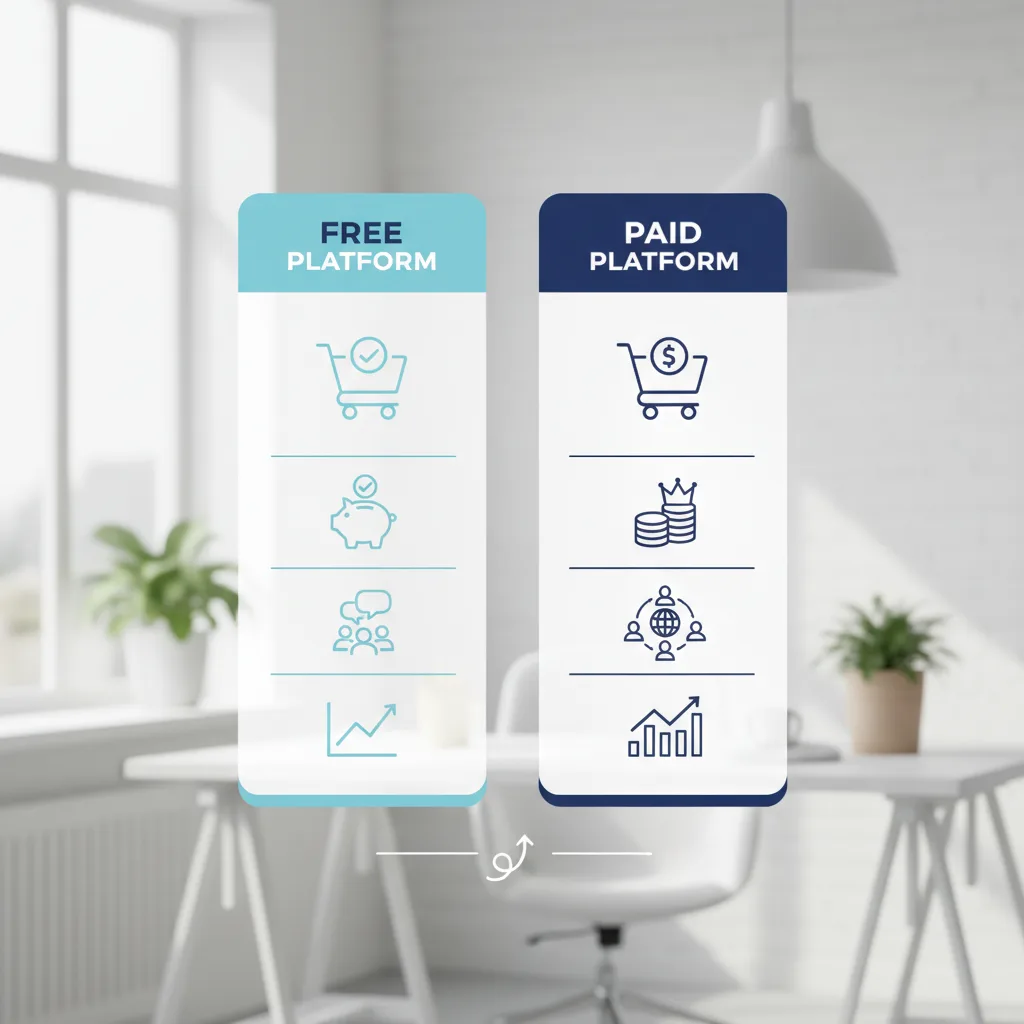
Here is what each free option takes on the same monthly sales, as of September 2026, from each platform's own pricing page (Gumroad, Beacons, Linktree, Payhip). Card processing (Stripe or PayPal) applies on every platform, so it is left out to keep the comparison fair. Gumroad's $0.50 per sale assumes a $25 average price: 20 sales at $500, 80 sales at $2,000. The shopspace line uses the Creator plan at $19 a month billed yearly ($29 month to month).
| Platform (plan) | Cut per sale | Taken on $500/mo | You keep | Taken on $2,000/mo | You keep |
|---|---|---|---|---|---|
| Payhip (Free Forever) | 5% | $25 | $475 | $100 | $1,900 |
| Beacons (Free) | 9% | $45 | $455 | $180 | $1,820 |
| Gumroad (no plan) | 10% + $0.50 | $60 | $440 | $240 | $1,760 |
| Linktree (Free) | 12% | $60 | $440 | $240 | $1,760 |
| shopspace (Creator) | 0%, flat $19/mo | $19 | $481 | $19 | $1,981 |
A few details make some of these cost more than the table shows. Gumroad's cut becomes a flat 30% on sales that come through its Discover marketplace (that 30% includes processing). Upgrading does not always remove the cut either: Beacons still takes 9% on its $10 a month Creator plan and only drops to 0% on Creator Plus at $30 a month, and Linktree still takes 9% on its paid Starter and Pro plans.
On $2,000 a month in sales, those free plans take $100 to $240 you never see. Start a 7-day free trial of shopspace and keep it: 0% per sale, flat $19 a month billed yearly.
When a free storefront is the right choice
Free is not a trick, and for some creators it is the better deal. Here is where a flat $19 a month starts costing less than each cut:
| Free option | A flat $19 costs less once you sell more than |
|---|---|
| Payhip Free (5%) | $380 a month |
| Beacons Free (9%) | about $211 a month |
| Gumroad (10% + $0.50) | about $158 a month, at a $25 average price |
| Linktree Free (12%) | about $158 a month |
Pick a free storefront if one of these fits you:
- You are still testing an idea. Below those numbers, a percentage is honestly cheaper than any subscription. There is no shame in starting there and moving once sales are steady.
- You want a marketplace to send you buyers. Gumroad's Discover marketplace can put your product in front of people who have never heard of you, at that 30% rate. shopspace has no marketplace: you bring the traffic.
- You want someone else to handle sales tax and VAT. Gumroad acts as merchant of record, and Payhip collects and remits EU and UK VAT, even on its free plan. shopspace does not; payments go to your own Stripe account and tax stays with you.
- You want a custom domain without paying. Payhip includes every feature on its free plan, custom domain included. On shopspace a custom domain is part of Pro.
If that is where you are, how to sell digital products for free walks through the free routes step by step.
Why I built shopspace around a flat price instead
Every creator platform I looked at when I started building charged money before you'd made any. I kept thinking: if I were a writer with one PDF to sell, or a coach with three spots to fill, I wouldn't pay $29 a month to find out if this works. I'd want to try it first.
That $29 entry price keeps showing up in this space. I spent weeks trying to justify it from a builder's perspective, and the math never worked for me. A creator who sells a $47 ebook needs to move at least one copy a month just to cover the platform, before they've figured out their audience, their pricing or their checkout flow.
The percentage model is more honest in one direction: you only pay when you earn. But 10% is a meaningful cut at scale. Sell $2,000 in a month and you're leaving $200 on the table, plus the per-sale fees stacking on top. I wanted to build something where the platform wins when the creator wins, not before, and not a little more every time they grow.
So I drew one line early: 0% of every sale, on every plan. I haven't moved it.

What did change is the price. Storage, compute, payment infrastructure and email: none of it is free on the backend. In its early months shopspace cost nothing to use while the core was being proven. Today it is a flat subscription: Creator at $19 a month billed yearly ($29 month to month), and Pro at $39 billed yearly ($49 month to month) for AI automations and a custom domain. The "try it first" part lives on as the 7-day free trial on every plan.
What the first 100 signups taught me
I watched the first 100 people who created a store on shopspace closely: what they built, what they asked in support, what they came back for.
Most of them weren't starting from zero in terms of expertise. They were starting from zero in terms of infrastructure. A therapist who wanted to sell a journaling workbook. A developer selling a Notion template. A fitness coach offering a 4-week program PDF. People who knew exactly what they wanted to sell and had no interest in spending weeks learning a platform before they could find out if anyone would buy it.
Almost none of them had tried to monetize online before. Not because they lacked something to sell, but because the friction of starting always cost money, and they weren't ready to pay it yet.
That's the person I built this for. Not the creator with 50,000 followers who needs advanced analytics. The one who has something real to offer and wants to find out whether anyone will pay for it.
Why 0% per sale matters more than the monthly price
When someone makes their first sale, even a $10 sale, something shifts. They've proven the concept. A creator whose first $100 was fully theirs is far more likely to stay and to tell a friend than one who watched a slice of it disappear.
The same logic applies to fees at every size. When I look at what Gumroad actually takes per sale and compare it to zero, the creator doesn't just save money. They feel differently about the platform. Every sale is fully theirs. That feeling matters more than people admit. You can see it in the Stan Store alternatives conversation too: creators aren't looking for cheap, they're looking for fair.
And a percentage never stops growing. On $5,000 a month, a 9% cut is $450 a month. A flat $19 is still $19.
What to check before you pick any creator storefront
Whether you go free or paid, check these before you commit:
- The cut on the plan you will actually use. Look at when it drops and what the upgrade costs, not just the free tier.
- Where the money goes. Some platforms collect payments and pay you out later. On shopspace, payments go straight to your own Stripe account and shopspace never holds them.
- Product types. Make sure everything you plan to sell fits. shopspace covers digital downloads, physical products, courses with progress tracking, bookings for calls and coaching, memberships with community access, webinars and events, bundles, lead magnets and a tip jar.
- Email and automation. A storefront without email means another monthly tool. Beacons' free plan allows 50 email sends a month. The shopspace Creator plan includes email campaigns and sequences, automations on store events, and Instagram auto-DM on comments.
- Custom domain. Payhip includes it free, Beacons starts it on the paid Creator plan, and on shopspace it is a Pro feature.
If memberships or recurring revenue are part of the plan, how to build a paid membership site covers the mechanics.
So, should you use a free creator storefront?
If you are testing your first product and selling less than the break-even numbers above, yes: a free storefront is the cheaper place to start, and Payhip's 5% is the lowest cut in this comparison. If you need a marketplace or merchant-of-record tax handling, Gumroad and Payhip do things shopspace does not.
Once your sales are steady, the free plan quietly becomes the expensive one. That is the point where I built shopspace to take over: one store for downloads, courses, bookings and memberships, email and Instagram automations included, and 0% of every sale left in your account.
Try shopspace free for 7 days. A card is required at signup and nothing is charged during the 7 days, so if you cancel inside the trial you pay nothing.