Payhip Pricing: A Detailed Breakdown of Fees (2026)
Payhip pricing: free with 5% per sale, $29 a month with 2%, or $99 a month with 0%. Which plan is cheapest at $500, $2,000 and $5,000 a month.

Payhip pricing has three plans. Free Forever costs $0 a month and takes 5% of each sale. Plus costs $29 a month and takes 2%. Pro costs $99 a month and takes 0%. Every plan includes every feature, and PayPal or Stripe charge their own processing on top of all three.
So the real question is which plan is cheapest at your sales volume, and the answer changes at about $967 and $3,500 a month. If you would rather keep every sale, shopspace charges 0% per sale for a flat $19 a month billed yearly, and you can try shopspace free for 7 days to compare on your own numbers.
Below: each Payhip plan, the fee math at $500, $2,000 and $5,000 a month, what's included, and when Payhip is the better choice.
Payhip Plans and Fees (As of September 2026)
All figures are from Payhip's pricing page:
| Plan | Monthly price | Fee per sale | Features |
|---|---|---|---|
| Free Forever | $0 | 5% | All features |
| Plus | $29 | 2% | All features |
| Pro | $99 | 0% | All features |
Two details are easy to get wrong. First, the $29 Plus plan doesn't remove the fee; it lowers it to 2%. Only Pro, at $99 a month, gets you to 0%. Second, Payhip doesn't hold features back for paid plans. The free plan has everything the paid plans have, including a custom domain and email marketing. You're only choosing how you pay: a bigger cut per sale, or a bigger monthly bill.
Signing up needs no credit card.
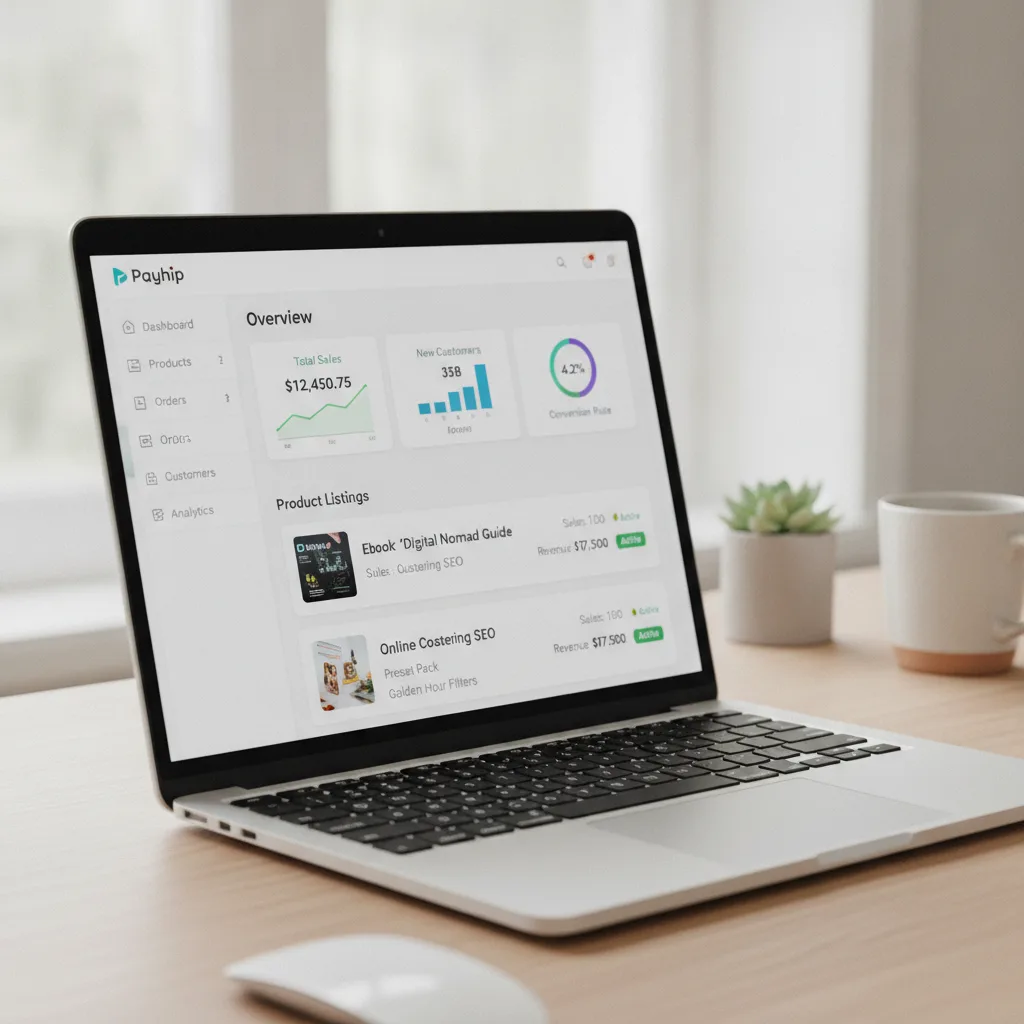
Payhip Transaction Fees Explained
Here's everything Payhip charges per sale:
- Platform fee: 5% on Free, 2% on Plus, 0% on Pro. There's no fixed per-sale charge on top.
- Card processing: PayPal and Stripe charge their standard rates on every plan.
- Taxes: Payhip collects and remits EU VAT and UK VAT for you automatically.
- Payouts: the money is paid out right after a transaction completes.
That VAT handling is a real advantage. If you sell digital products to buyers in Europe, it's paperwork you don't have to do.
Which Payhip Plan Is Cheapest? The Math
A percentage fee is cheap when sales are small and expensive when they grow. Here's what you keep each month on each Payhip plan, next to shopspace Creator at $19 a month billed yearly and 0% per sale. The platform's cost is in brackets. Card processing (Stripe or PayPal) applies on every platform, so it is left out to keep the comparison fair.
| Monthly sales | Payhip Free (5%) | Payhip Plus ($29 + 2%) | Payhip Pro ($99, 0%) | shopspace Creator ($19, 0%) |
|---|---|---|---|---|
| $500 | $475 ($25) | $461 ($39) | $401 ($99) | $481 ($19) |
| $2,000 | $1,900 ($100) | $1,931 ($69) | $1,901 ($99) | $1,981 ($19) |
| $5,000 | $4,750 ($250) | $4,871 ($129) | $4,901 ($99) | $4,981 ($19) |
The break-even points between Payhip's own plans:
- Free to Plus: Plus saves you 3% per sale for $29, so it pays off above about $967 a month in sales.
- Plus to Pro: Pro saves you 2% more for another $70, so it pays off above $3,500 a month.
And against shopspace: Payhip Free's 5% passes $19 at $380 a month in sales. On shopspace's month-to-month price of $29, the crossover is $580. Below those numbers, Payhip Free costs you less.
At $2,000 a month, the cheapest Payhip plan still costs you $69, while shopspace is a flat $19 at 0% per sale. Start a 7-day free trial of shopspace and keep the $50 difference every month.
Features Included in Each Plan
Because Payhip has no feature gating, this list is the same on Free, Plus and Pro:
- What you can sell: digital downloads, online courses, coaching, memberships and physical products.
- Custom domain: included on every plan.
- Email marketing: included on every plan.
- EU and UK VAT: collected and remitted automatically.
- Instant payouts after each completed transaction.
Comparing Payhip and Competitors
Against the other popular options, as of September 2026:
- Gumroad: no monthly fee, 10% + $0.50 per direct sale, with processing on top, and 30% on sales from its Discover marketplace. Payhip Free is cheaper per sale for anyone selling to their own audience.
- Stan Store: $29 a month on the Creator plan with 0% transaction fees. No free plan, but a 14-day free trial.
- Sellfy: 0% per sale from $29 a month ($22 billed yearly), no free plan, and a yearly sales cap on every plan.
If you're choosing between these, Stan Store vs Payhip and Payhip vs Sellfy vs shopspace go through them side by side.
Payhip vs shopspace
Where Payhip wins: it has a genuinely free plan with no card required, which is the right place to start if you haven't made a sale yet. It handles EU and UK VAT for you, and shopspace doesn't. And a custom domain is included on every Payhip plan, while on shopspace it's part of Pro ($39 a month billed yearly).
Where shopspace fits better: once you're past a few hundred dollars a month, 0% per sale for $19 a month billed yearly costs less than any Payhip plan. The Creator plan includes a storefront with checkout; unlimited products, courses and members; community, memberships and bookings; email campaigns and sequences; automations on store events; and Instagram automations that send a DM when someone comments on your post. Payments go straight to your own Stripe account.
Neither platform brings you buyers; you bring the traffic. If that's your next problem, how to sell digital products without monthly fees covers the low-cost ways to start.
The Verdict
Stay on Payhip Free if you're selling less than about $380 a month, or if you sell into the EU and want VAT taken care of. It's a fair deal at that size.
Past that point, you're paying Payhip more than a flat subscription would cost. At $2,000 a month, shopspace leaves you $50 a month more than Payhip's cheapest option, and the gap grows with every sale. Every shopspace plan starts with 7 days free; a card is required at signup, nothing is charged during the trial, and you pay nothing if you cancel inside it. Set up your store on shopspace with a 7-day free trial.